Accurate and confident reading depends on more than exposure to print. It relies on a student’s ability to hear, identify, and work with the sounds of spoken language at multiple levels. Decades of reading research have established phonological awareness and phonemic awareness as critical components of effective reading instruction, particularly within structured literacy frameworks.
At ROYO, both skill sets are intentionally integrated into the reading experience. These sound-based skills support students as they develop accuracy, confidence, and efficiency as readers and strengthen the connection between spoken language and print.
An Overview of Phonological and Phonemic Awareness
Phonological awareness refers to a broad set of skills related to recognizing and working with the sound structures of spoken language. These skills involve larger units of sound and include recognizing rhymes, identifying words within sentences, and working with syllables and word parts. Phonological awareness helps students attend to patterns in spoken language and build flexibility in how they process oral language.
Phonemic awareness is a more specific subset of phonological awareness. It focuses on individual phonemes, the smallest units of sound in spoken language. Phonemic awareness includes the ability to identify, compare, and manipulate individual sounds within words, a skill that directly supports sound-to-letter mapping during reading and spelling.
Both phonological and phonemic awareness are developed without print. Research consistently shows that together they support decoding, spelling, and fluent reading by strengthening students’ understanding of how spoken language maps onto written language.
Sound Awareness and Reading Development
A substantial body of reading research has demonstrated the importance of sound awareness in reading development. Findings synthesized by the National Reading Panel identified phonemic awareness as a strong predictor of reading success and emphasized the role of explicit sound-based instruction within a comprehensive approach to reading.
Subsequent research has further clarified that phonemic awareness does not develop in isolation. Broader phonological awareness skills, including rhyming, word awareness, and manipulation of larger sound units, contribute to students’ ability to attend to spoken language and support later phoneme-level work. When students can work flexibly with spoken language at multiple levels, they are better equipped to apply phonics knowledge accurately and efficiently.
Rather than functioning as stand-alone skills, phonological and phonemic awareness operate in coordination with phonics instruction, decoding practice, and meaningful reading experiences. This integrated approach supports accurate decoding, reduces reliance on guessing, and contributes to the development of efficient word recognition over time.
Sound Awareness Within ROYO’s Reading Instruction
Within ROYO, phonological and phonemic awareness activities are embedded intentionally as part of the reading experience. These activities are designed to strengthen students’ awareness of spoken language at both the word and sound level and to reinforce the sound-based skills that support accurate decoding.
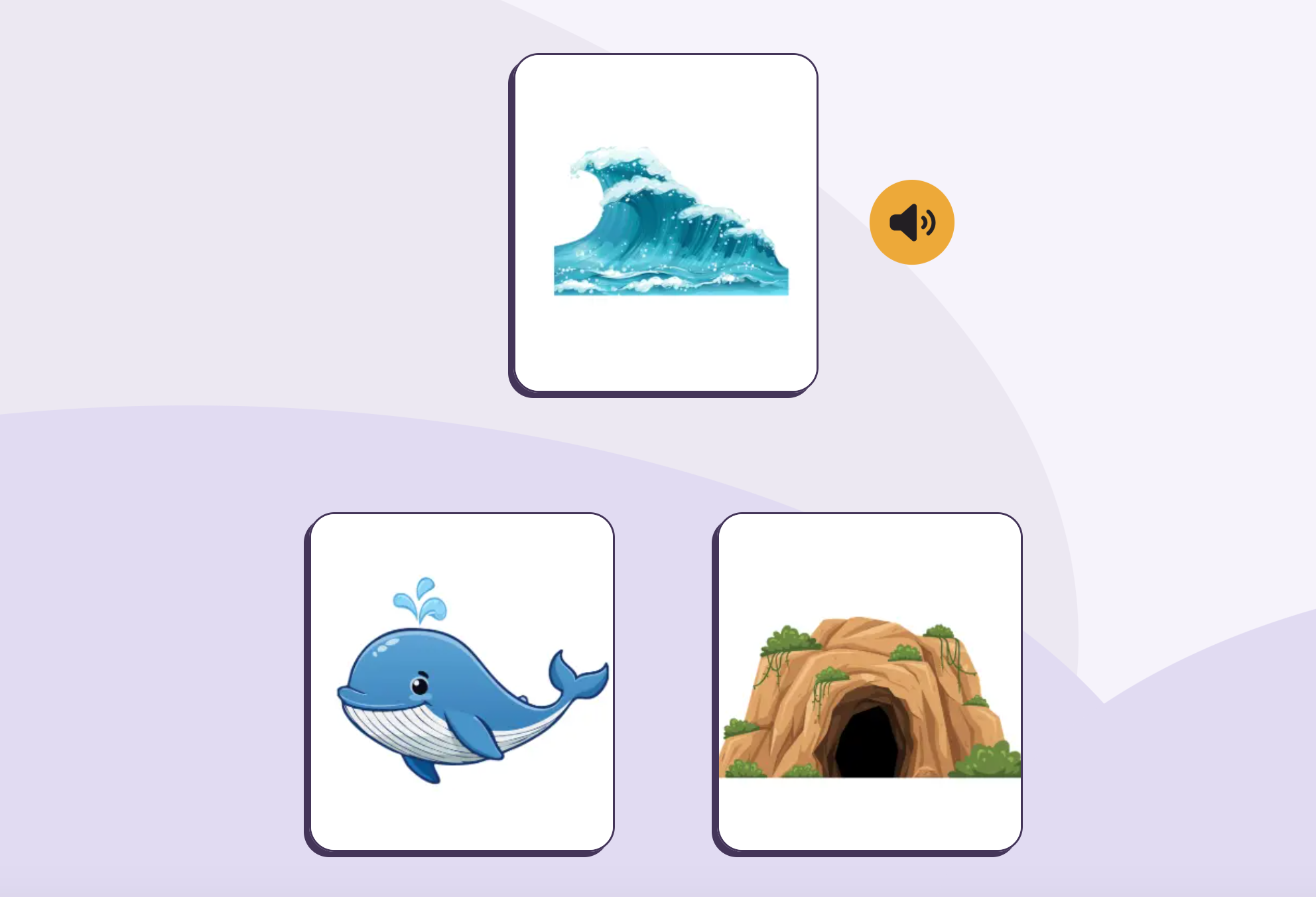
Instruction includes phonological awareness tasks such as rhyming and sentence-level word awareness, phonemic awareness tasks focused on identifying, matching, and manipulating individual sounds, and word-part manipulation activities that support flexibility with spoken language. These activities are brief and targeted, but they play an important role in supporting students as they engage with decodable texts and apply sound-to-print connections during reading.
Connections to Decodable Text Instruction
Decodable texts are most effective when students have strong underlying sound awareness. Phonological and phonemic awareness instruction supports students in approaching decodable reading with greater accuracy and confidence by strengthening the skills needed to apply phonics knowledge consistently.
Research indicates that when sound awareness instruction is integrated with phonics and reading practice, students demonstrate improved decoding, stronger word recognition, and greater reading accuracy. These benefits are particularly important for early readers and students with reading difficulties, but they support reading development across grade levels.
Sound Awareness Within Comprehensive Reading Instruction
Phonological and phonemic awareness are not isolated skills or one-time instructional steps. They are essential components of comprehensive reading instruction and play an ongoing role in supporting students’ reading development.
By intentionally incorporating both phonological and phonemic awareness into its instructional framework, ROYO supports the sound-based skills that make reading possible. When these skills are strengthened together and connected to decoding and reading practice, students are better positioned to read accurately, fluently, and with confidence.